A Practical, Learning-Based Guide to Organization, Roles, and Real-World Operations
Civil Defence is not just a department—it is a living system of preparedness, command, and community response. In Khyber Pakhtunkhwa (KPK), the Warden Structure is carefully designed so that every street, every household, and every citizen becomes part of a coordinated safety network.
This guide explains not only the hierarchy—but also how each role functions, how decisions flow, and how real emergencies are handled step by step.
1. Understanding the Philosophy Behind the Warden System
Before diving into ranks, it’s important to understand the core principle:
“Centralized Command, Decentralized Response.”
- Decisions are made at the top (Controller level)
- Actions are executed at the lowest level (Street / House Wardens)
This ensures:
- Faster response
- Local awareness
- Minimum chaos during emergencies
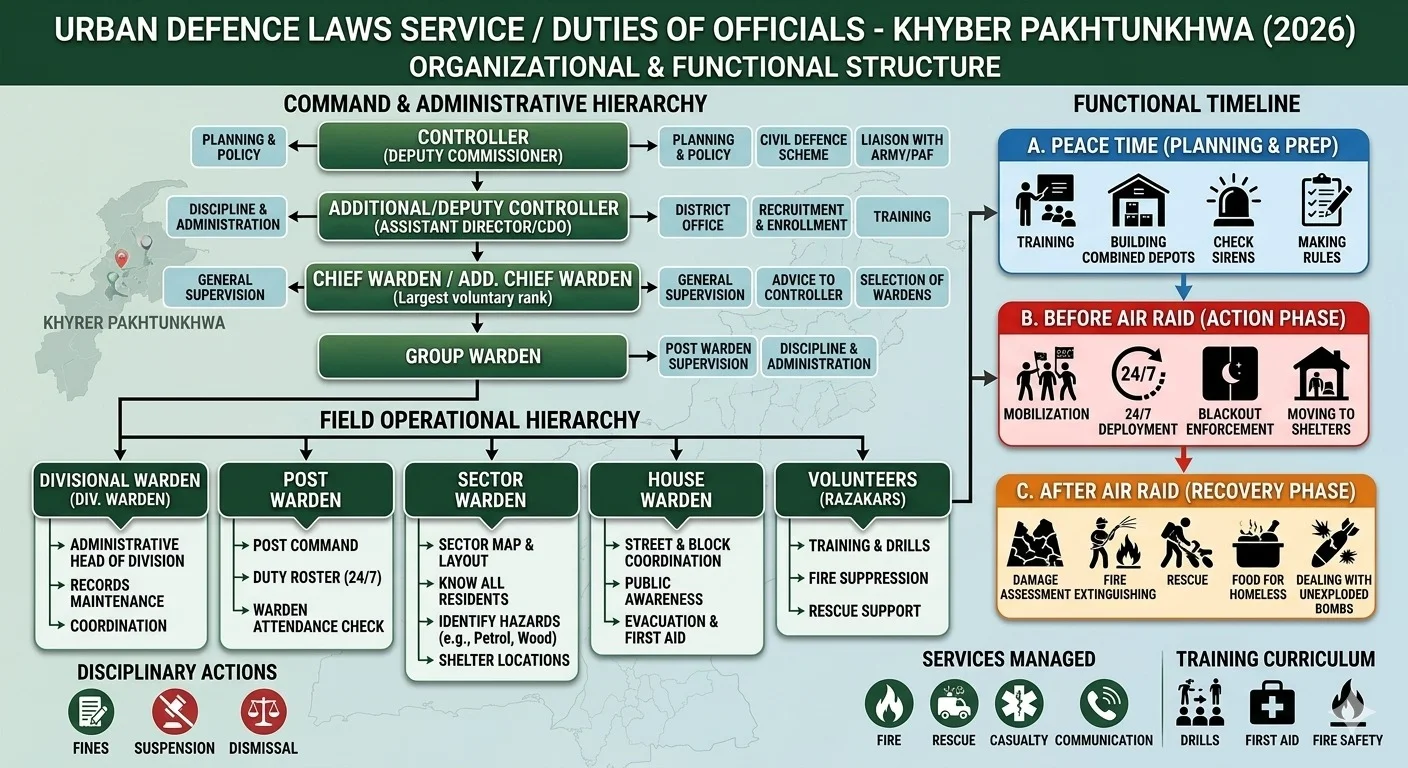
2. Command & Administrative Hierarchy (How Authority Works)
This level focuses on planning, control, and decision-making.
2.1 Controller (Deputy Commissioner)
Role: Strategic Commander
Think of the Controller as the “brain of the system.”
What They Actually Do:
- Declare emergency status
- Activate Civil Defence system
- Coordinate with:
- District administration
- Police
- Health departments
- Military (Army / PAF if required)
Real Scenario Learning:
If an air threat or disaster is reported:
- Controller receives intelligence
- Orders activation of sirens
- Directs Deputy Controller to mobilize wardens
- Coordinates evacuation strategy
👉 Key Skill: Decision-making under pressure
2.2 Additional / Deputy Controller
Role: Operational Executor
Acts as the “engine of the system.”
Core Responsibilities:
- Converts strategy into action
- Issues orders to Chief Warden
- Manages:
- Training schedules
- Volunteer databases
- Resource allocation
Real Scenario:
- Receives order → activates control room
- Sends alerts to all wardens
- Deploys teams based on risk zones
👉 Key Skill: Coordination & logistics
2.3 Chief Warden / Additional Chief Warden
Role: Field Command Leader
The highest-ranking volunteer authority.
Responsibilities:
- Controls all wardens in the district
- Assigns duties to Group Wardens
- Maintains discipline
- Advises administration on ground realities
Learning Insight:
This role is critical because:
- Administration may not know street-level realities
- Chief Warden provides real-time feedback from the ground
👉 Key Skill: Leadership + field intelligence
2.4 Group Warden
Role: Tactical Coordinator
Acts as a bridge between planning and execution.
Responsibilities:
- Supervises multiple Post Wardens
- Ensures:
- Duty rosters are active
- Teams are ready
- Maintains communication flow
Real Scenario:
- Receives instruction → distributes tasks:
- “Post A: Evacuate sector”
- “Post B: Activate shelters”
👉 Key Skill: Multi-team coordination
3. Field Operational Hierarchy (Where Real Action Happens)
This is the most critical layer, where actual response takes place.
3.1 Divisional Warden
Role: Area Administrator
- Controls a large geographic division
- Maintains records of:
- Personnel
- Resources
- Coordinates between sectors
👉 Think of them as mini administrators of a zone
3.2 Post Warden
Role: Local Command Center
This is where operations become real.
Responsibilities:
- Runs a Civil Defence post
- Maintains 24/7 duty system
- Tracks attendance of wardens
- Acts as emergency reporting hub
Real Scenario:
- Receives call: “Fire in Sector 3”
- Immediately:
- Dispatches volunteers
- Alerts Sector Warden
- Reports upward
👉 Key Skill: Quick decision-making
3.3 Sector Warden
Role: Intelligence & Planning at Local Level
Responsibilities:
- Knows:
- Every street
- Every building
- Every risk point
- Identifies:
- Hazardous materials
- Narrow roads
- Safe shelters
Learning Insight:
Sector Warden is like a “human map system.”
👉 In emergencies:
- No time to “figure out routes”
- They already know everything
👉 Key Skill: Situational awareness
3.4 House Warden
Role: Community Connector
This is the most powerful role for public interaction.
Responsibilities:
- Handles a street/block
- Educates residents:
- What to do during siren
- Where to go
- Helps in:
- Evacuation
- First aid
Real Scenario:
- Siren rings
- House Warden:
- Guides الناس to shelter
- Prevents panic
- Assists elderly
👉 Key Skill: Communication & trust-building
3.5 Volunteers (Razakars)
Role: Frontline Force
These are the hands of Civil Defence.
Responsibilities:
- Fire fighting
- Rescue operations
- Carrying injured
- Assisting evacuation
Learning Insight:
Without volunteers:
👉 System = Structure only
👉 With volunteers:
👉 System = Action
👉 Key Skill: Physical readiness + discipline
4. Functional Timeline (How System Works Over Time)
4.1 Phase A: Peace Time (Preparation Phase)
Focus: Readiness
- Training drills
- Equipment maintenance
- Siren testing
- Public awareness
👉 Learning Principle:
“The more you sweat in training, the less you bleed in emergency.”
4.2 Phase B: Before Air Raid (Action Phase)
Focus: Immediate Response
- Mobilization of all wardens
- 24/7 alert mode
- Blackout enforcement
- Movement to shelters
Key Training Concept:
Speed + Discipline = Lives Saved
4.3 Phase C: After Air Raid (Recovery Phase)
Focus: Damage Control
- Rescue injured
- Control fires
- Provide food & shelter
- Handle unexploded bombs
👉 Critical Skill:
Calmness under chaos
5. Communication Flow (Most Important Learning Section)
Top → Down Flow
Controller → Orders → Field Units
Bottom → Up Flow
Street → Reports → Controller
👉 This ensures:
- No confusion
- No duplication
- No delay
6. Practical Example (Full Scenario Simulation)
Situation: Air Threat Alert
- Controller
- Issues emergency order
- Deputy Controller
- Activates system
- Chief Warden
- Mobilizes wardens
- Group Warden
- Assigns sectors
- Post Warden
- Activates local teams
- Sector Warden
- Identifies routes & shelters
- House Warden
- Guides residents
- Volunteers
- Execute rescue & support
👉 Result: Organized response instead of chaos
7. Discipline System (Why It Matters)
Without discipline, the system fails.
Actions Include:
- Fines
- Suspension
- Dismissal
👉 Ensures:
- Accountability
- Professionalism
- Reliability
8. Key Learning Takeaways
✔ Every level has a clear purpose
✔ Communication is structured and controlled
✔ Training is continuous, not optional
✔ Community involvement is essential
✔ System works only when everyone plays their role
Conclusion
The Civil Defence Warden Structure in Khyber Pakhtunkhwa is not just an organizational chart—it is a complete operational ecosystem designed to protect lives.
When properly trained and executed, it transforms:
👉 Ordinary citizens → Organized responders
👉 Panic → Controlled action
👉 Disaster → Managed situation
“Civil Defence is not a force of reaction — it is a system of preparation.”
Join a trained network of Civil Defence volunteers protecting communities across
Khyber Pakhtunkhwa.

1 Comment
Good