
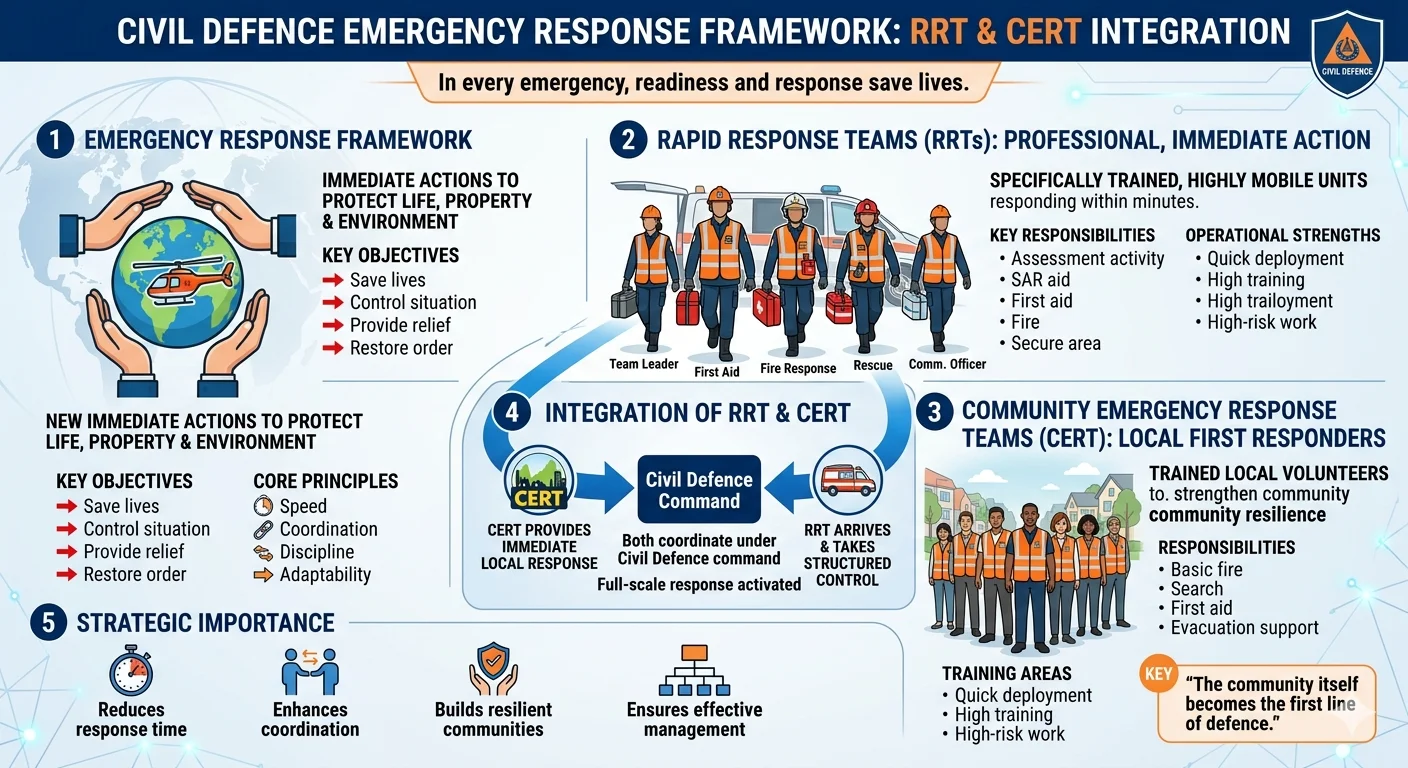
An effective Civil Defence system depends on its ability to respond quickly, act efficiently, and coordinate seamlessly during emergencies. This is achieved through trained personnel, structured response teams, and community-level engagement.
1. Emergency Response Framework
Emergency response refers to the immediate actions taken to protect life, property, and the environment during and after a disaster.
Key Objectives:
- Save lives and reduce injuries
- Control and contain the situation
- Provide immediate relief and assistance
- Restore order and stability
Core Principles:
- Speed: Immediate activation and deployment
- Coordination: Clear communication across all levels
- Discipline: Following chain of command
- Adaptability: Responding effectively to changing conditions
2. Rapid Response Teams (RRTs) During Disasters
Role: First Line of Organized Action
Rapid Response Teams are specially trained, highly mobile units designed to respond within minutes of an incident.
They act as the initial professional response force, bridging the gap between incident occurrence and full-scale emergency deployment.
Key Responsibilities:
- Immediate assessment of the situation
- Search and rescue operations
- First aid and casualty stabilization
- Fire suppression (initial stage)
- Securing the affected area
- Reporting real-time updates to command centers
Team Composition:
A typical Rapid Response Team may include:
- Team Leader
- First Aid Responders
- Fire Response Personnel
- Rescue Workers
- Communication Officer
Operational Strengths:
✔ Quick deployment and mobility
✔ High level of training and discipline
✔ Ability to operate in high-risk environments
✔ Effective coordination with higher command
Practical Scenario Example:
In case of a building collapse:
- RRT arrives within minutes
- Secures the area to prevent further risk
- Begins search and rescue operations
- Provides first aid to injured individuals
- Reports situation to higher authorities
- Supports arrival of additional emergency services
3. Community Emergency Response Teams (CERT)
Role: Community-Based First Responders
CERT teams are composed of trained local volunteers who act as the first point of response within their own communities.
They are critical in situations where professional responders may take time to arrive.
Purpose of CERT:
- Strengthen community resilience
- Provide immediate assistance at neighborhood level
- Support Civil Defence and emergency services
- Reduce panic and chaos
Key Responsibilities:
- Basic fire suppression
- Light search and rescue
- First aid and casualty care
- Assisting in evacuation
- Spreading awareness and guidance
Why CERT is Important:
- Disasters often impact communication and mobility
- Local volunteers are already present in the area
- They can act within seconds, not minutes
Training Areas for CERT Members:
- Disaster preparedness
- Fire safety
- First aid and CPR
- Evacuation techniques
- Communication protocols
Community Impact:
CERT teams transform communities from passive victims into active responders.
Key Concept:
“The community itself becomes the first line of defence.”
4. Integration of RRT & CERT in Civil Defence System
The strength of Civil Defence lies in combining:
- Rapid Response Teams (Professional, Immediate Action)
- CERT Teams (Local, Community-Level Support)
How They Work Together:
- CERT provides immediate local response
- RRT arrives and takes structured control
- Both coordinate under Civil Defence command
- Full-scale emergency response is activated
5. Strategic Importance
✔ Reduces response time significantly
✔ Enhances coordination between authorities and public
✔ Builds resilient and prepared communities
✔ Ensures effective disaster management at all levels
Conclusion
Emergency response is not a single action—it is a coordinated system of trained teams, structured planning, and community participation.
With the integration of Rapid Response Teams and Community Emergency Response Teams (CERT), Civil Defence ensures that:
- Help arrives quickly
- Communities are prepared
- Lives are protected
“In every emergency, readiness and response save lives.”
Join a trained network of Civil Defence volunteers protecting communities across
Khyber Pakhtunkhwa.
